The Milford Track | New Zealand’s Greatest Walk
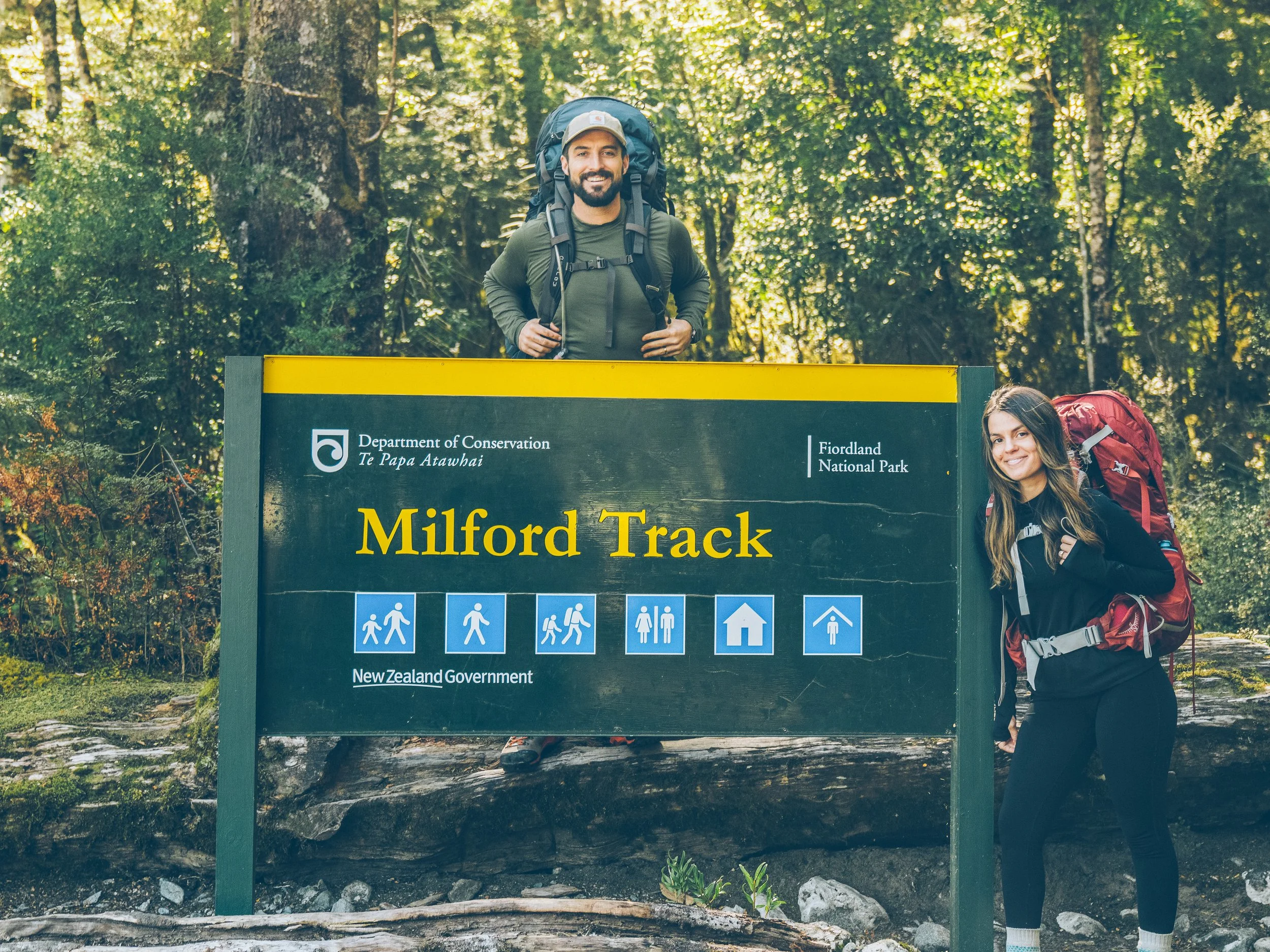
I first walked the Milford Track as a twelve-year-old, soaked to the bone and wondering what I’d gotten myself into. More than two decades later, I returned to walk it again with my wife. This is the story of both journeys, followed by a practical guide to help you plan your own.
Field Notes - The mIlford Track
Cold driving rain pelted my face and stung my eyes. I squinted through the thick fog, not quite sure if it was raining or if it was snowing. The distinction didn’t matter. I was a soaked, near-frozen, pimply little prepubescent twelve-year-old with an attitude. Disoriented and on the verge of crying, I swear it was rain, not tears, I was certain of one thing. This was the hardest undertaking I had ever done in my life. I wanted to quit, but I needed to continue. I needed shelter.
Looking back at that moment 26 years later, it's funny how a single day can help shape the path we take in life. I was on the Milford Track, arguably the world’s best multi-day hiking adventure, halfway up Mackinnon Pass, a rugged, thickly forested goat trail winding over New Zealand’s Southern Alps in one of the rainiest places on planet Earth. While I didn’t know it then, looking back now, I realize that’s the moment something clicked.
After the rainy tears, after the despair, a smile tickled and crept across my lips, and I was overcome with an uncontrollable urge to laugh.
Ten minutes later I was sitting by a crackling fire, warming my numb fingers with a cup of hot chocolate as the wind whipped against the iron sheeting of the Mackinnon Pass shelter. While it was nothing more than some framing, a few rough-hewn benches stained with sweat and smelling of damp socks, it was delightful. I was addicted. I knew I’d have to come back, I just wasn’t sure when.
I’ve never been the type of person to do the same thing twice. I spent my twenties voraciously acquiring new life experiences. After graduating from university, I wanted to experience the world viscerally, understand it better firsthand, and rarely felt drawn to return to places I’d already visited.
As I’ve grown older, I’m realizing that some places deserve to be felt more than once. The place may not have changed much, but you have. When I decided to follow my own footsteps down the Milford Track again, this time with my wife instead of my nuclear family, I wasn’t quite sure what to expect. It had been over two decades. I wasn’t a kid, yet somehow I found myself in almost an identical situation. Out of breath, soaked with sweat, and approaching the summit of the same mountain pass named after the Scottish surveyor who bushwhacked through this primeval forest in the late 1800s, I had an epiphany.
The further I push my body, the closer my brain feels to some sort of fleeting nirvana.
Nothing snaps you out of a philosophical daydream like backpack straps digging into your shoulders. I was carrying twenty extra pounds of cinema camera equipment, lenses, tripods, two camera bodies, a GoPro, spare batteries, a JetBoil stove, and a tub of Vaseline (if you know, you know).
Two decades later, the same place, and the same driving rain and thick fog. My first time up the mountain as a kid, I had missed the supposedly jaw-dropping view from the summit. It was shaping up to be the same.
I boiled some water and handed my wife a steaming cup of instant coffee, which is better than nothing but not particularly great. This time, however, she accepted it gratefully. We sipped in silence, staring at the crackling fire. Always a good sport, she somehow let me convince her that this would be fun. Perhaps the grueling climb made her second guess that assumption. I watched as her eyes glazed over, lost in deep thought.
“I’m not sure we’re going to see much,” I said to her quietly. “We can wait a bit longer but we can’t stay up here all day. We’ve still got to get off this mountain.”
She took a moment before turning towards me and speaking. “I think we’ll get lucky.” She smiled slyly and then added. “This coffee somehow tastes better up here.”
Ten minutes later, after shaking the wet from our outercoats and shouldering our burdensome packs, we stepped back into the elements. The wind whistled as the old hut door swung open, nearly knocking me off my feet. I glanced back at my wife, who was still smiling. “Ready for that view?” she grinned.
The fog seemed thicker than before, and we stumbled along the ridgeline in whiteout conditions, tripping on stones and moorland shrubs. I had resigned myself to my fate, no view, no luck, no need to dilly-dally. It was time to get off the mountain.
Yet, all of a sudden, the wind died down. It fell from a howling gale to a soft breeze. For a moment everything seemed to stand still. I could hear the water droplets slowly dripping off the tussock grass. With each footstep closer to the cliff’s edge, the clouds retreated, and just like that the fog drifted upwards in dancing spirals. Muted grey light poked through the softening cloud. Then blue sky shone through, at first in small patches and then in swathes. A moment later, as if by magic, sunshine. Mountain peaks surrounded us, glaciers clung precariously to the sharp granite peaks. Silence; crisp, golden silence.
What seemed only moments earlier like a lost cause miraculously changed into a clear sunny day, and we were rewarded with what I feel is one of New Zealand’s best views. Craggy granite mountain tops, sprinkled with a dusting of snow and ancient glaciers, towered over a thickly forested valley. Waterfalls emerged from the fog, some tumbling hundreds of meters through the air before crashing into the broken rocks below. It felt surreal.
“I guess you were right honey.”
Perhaps it’s cliché, but in my experience, this has happened more often than pure coincidence. Whenever I’ve been close to quitting, to giving up and giving in, if I just hold tight for one moment longer, something special happens. The tide slackens and the winds of fortune gently change direction.
Or maybe I’m just seeing things the way I want them to be seen. Clearly, with a light garnish of the sublime. I’ll take a foggy waterfall with a side of blue sky any day. That type of magic abounds down here, you just have to put yourself in a position to experience it.
If you read on below, I’ll share exactly how to best do that.
The Milford Track Documentary by Alexander Ayling.
Planning the Milford Track: Everything You Need to Know
So, you’ve seen why I love this place. Now let’s get practical.
The Milford Track is 53.5 km (33.2 miles) long and cuts directly through the heart of Fiordland National Park, from the northern end of Lake Te Anau to Milford Sound/Piopiotahi.
Unlike plenty of other hikes in New Zealand, you can’t really freestyle this one. During the Great Walk season, the Milford Track is walked in one direction, over four days and three nights, staying at three specific DOC huts along the way.
It also happens to be one of the hardest Great Walk bookings to get in New Zealand. Last year bookings sold out in 34 minutes.
That shouldn’t scare you off. It just means you need to know what you’re doing before you start clicking.
Table of Contents
Milford Track at a Glance
How Difficult Is the Milford Track?
How to Book the Milford Track
Independent vs. Guided Milford Track
How to Get to the Milford Track
Milford Track Day-by-Day
What Are the Milford Track Huts Like?
Mackinnon Pass
Sutherland Falls
Milford Track Weather
Best Time to Walk the Milford Track
What to Pack
Food and Water
Cell Service and Safety
Walking Outside the Great Walk Season
Milford Track FAQ
Planning a Bigger New Zealand Trip

Clouds parting as we descend Mackinnon Pass, the highest point on the Milford Track.
Milford Track at a Glance
Distance: 53.5 km / 33.2 miles
Time: 4 days / 3 nights
Direction: One way
Start: Glade Wharf, Lake Te Anau
Finish: Sandfly Point, Milford Sound/Piopiotahi
Highest point: Omanui/Mackinnon Pass — 1,154 m / 3,786 ft
Huts: Clinton Hut, Mintaro Hut, Dumpling Hut
Camping: Not permitted
Great Walk season: November through April
Difficulty: Moderate overall, with one significant alpine crossing and a long final day
Cell coverage: None
Biggest wildcard: The weather. Always the weather.
How Difficult Is the Milford Track?
The Milford Track isn't technically difficult, but that doesn't mean it's easy.
The trail itself is generally well formed during the Great Walk season. You don't need mountaineering skills, and for most reasonably fit hikers the daily distances are manageable.
The difficulty comes from three things: weather, elevation, and carrying everything you need for four days.
Day Three is the crux of the hike. You climb more than 500 vertical meters to Mackinnon Pass and then descend roughly 1,000 meters toward Dumpling Hut. If you've got bad knees, you'll probably notice the descent more than the climb.
Day Four is 18 km, and unlike a normal hike where you can take as long as you like, you've got a boat to catch at Sandfly Point.
Add persistent rain, slippery rocks, mud and a backpack full of food and equipment, and suddenly 18 km can feel considerably longer.
You don't need to be an elite athlete. You should, however, be comfortable spending five to seven hours on your feet for several consecutive days while carrying a loaded backpack.
Train for that, rather than obsessing over your fastest 5K time.
How to Book the Milford Track
This is the part you want to pay attention to.
During the Great Walk season, independent walkers must book all three huts in sequence:
Clinton Hut
Mintaro Hut
Dumpling Hut
You can't skip a hut, camp instead, reverse the route or spend an extra night halfway through.
That limited capacity is part of what makes the Milford Track so special. It also makes bookings extremely competitive.
For some context, the initial allocation for the 2026/27 season sold out in 34 minutes, with 13,500 people hitting the DOC booking system.
So don't casually remember booking day at lunchtime and expect everything to work out.
My advice for booking day
Create your DOC account well in advance.
Make sure you actually know your password.
Know your preferred dates before bookings open, but have several alternatives ready.
Be logged in and ready before the booking system opens.
If your first dates disappear, move quickly to Plan B.
And don't book flights around the Milford Track until you've actually secured your huts.
Current 2026/27 Milford Track Hut Prices
During the Great Walk season, adult hut rates are currently:
New Zealand adults: NZ$106 per person, per night
International adults: NZ$152 per person, per night
Children are charged at reduced rates, and proof of eligibility is required for New Zealand pricing.
Prices and opening dates can change from season to season, so always confirm the current details directly with DOC before planning your trip.
Independent vs. Guided Milford Track
There are two fundamentally different ways to walk the Milford Track.
Independent
This is how I walked it as an adult.
Independent walkers stay in Department of Conservation huts and carry their own:
Food
Clothing
Sleeping bag
Camera gear
Toiletries
Cooking and eating utensils
Personal equipment
DOC provides the hut, bunk, mattress, basic cooking facilities, water, toilets and a place to dry out.
The rest is up to you.
Personally, I love this style of travel because there's something deeply satisfying about knowing everything you need for the next four days is sitting on your back.
Even when your shoulders disagree.
Guided
This is how I walked it with my family as a kid. It was a guided experience and is considerably more comfortable.
Guided walkers use separate private lodges and packages can include transport, guides, meals, snacks, accommodation and equipment. The lodges offer comforts you won't find in the DOC huts, including hot showers and proper beds.
It's a very different experience, and also considerably more expensive.
Neither is inherently better.
If you want a classic New Zealand tramping experience and are comfortable carrying your own gear, go independent.
If you'd rather concentrate on walking while someone else handles the logistics, food and accommodation, the guided option may be worth the premium.

The Milford Track begins by taking a boat across Lake Te Anau to the trailhead. It’s an awesome way to start the adventure.
How to Get to the Milford Track
This is one of the most important logistical details because you cannot drive to either end of the Milford Track.
The journey is part of the adventure.
Getting to the Start
Most independent walkers begin in Te Anau.
From Te Anau, you'll travel about 30 minutes by bus or private transport to Te Anau Downs.
From there, you board a boat across Lake Te Anau.
The cruise takes approximately 1 hour 15 minutes and deposits you at Glade Wharf, deep inside Fiordland National Park.
There's something fantastic about starting a hike this way.
The road disappears behind you, the boat pulls away from the dock, and suddenly you realize there really isn't an easy way back.
Getting Out
Four days later, you finish at Sandfly Point.
And yes, the name is accurate.
From Sandfly Point, a boat takes you approximately 20 minutes across the water to Milford Sound/Piopiotahi.
From Milford Sound you can arrange onward transportation back toward Te Anau or Queenstown.
Book your track transport in advance.
Your hut reservation doesn't magically include every bus and boat required to get you in and out.
Book Your Flights Now!
Milford Track Day-by-Day
Day One: Glade Wharf to Clinton Hut
Distance: 5 km / 3.1 miles
Time: 1–1.5 hours
Day One almost feels suspiciously easy.
After crossing Lake Te Anau, you leave Glade Wharf and follow the Clinton River through native beech forest toward Clinton Hut.
It's only five kilometers.
Don't let that lull you into thinking the entire Milford Track is going to be this relaxing.
Think of Day One as an introduction.
Settle into the hut, get your backpack organized, explore the surrounding area and enjoy being deep inside Fiordland with three full days of walking ahead of you.

Getting dropped off by the Water Taxi at the start of the Milford Track. The first real taste of Fiordland.
Day Two: Clinton Hut to Mintaro Hut
Distance: 17.5 km / 10.9 miles
Time: Approximately 6 hours
This is where the scale of Fiordland begins to reveal itself.
The trail follows the Clinton River deeper into the valley while the walls rise around you. Waterfalls spill down the cliffs, the vegetation begins to change and Mackinnon Pass slowly emerges ahead.
You eventually climb toward Lake Mintaro and Mintaro Hut, which sits below the pass you'll cross the following morning.
Get some sleep.
Tomorrow is the big one.

Day Three: Mintaro Hut to Dumpling Hut
Distance: 13 km / 8.1 miles
Time: 6–7 hours
This is the day most people remember.
From Mintaro Hut, the trail begins climbing toward the Mackinnon Memorial before reaching Omanui/Mackinnon Pass at 1,154 meters.
On a clear day, the views back down the Clinton Valley are ridiculous.
On a wet day, you'll understand the opening Field Note above.
The descent from the pass drops roughly 1,000 meters through alpine vegetation and rainforest toward the Arthur Valley.
It's beautiful.
It's also a serious workout for your knees. A BIG MISTAKE we made was not bringing trekking poles. The descent was brutal, and literally brought my wife to tears. I was limping my way to the hut by the end of the day. Trekking poles make this section much less demanding.
Near the bottom, you'll have the option of adding the side trip to Sutherland Falls before continuing to Dumpling Hut for the final night.

This beautiful view hides a grueling descent.
Day Four: Dumpling Hut to Sandfly Point
Distance: 18 km / 11.2 miles
Time: 5.5–6 hours
The longest day comes last.
The trail follows the Arthur River toward Milford Sound, passing waterfalls, forest and Lake Ada before finally emerging at Sandfly Point.
You'll want to keep an eye on the clock.
The boat doesn't care how many photographs you stopped to take.
After three nights in the backcountry, reaching Milford Sound by boat feels like a fitting end to the journey.
Book Your Hotel For the End of the Track
What Are the Milford Track Huts Like?
If you're expecting a hotel, recalibrate.
If you've spent time in genuinely basic backcountry huts, however, the Milford Track huts are pretty luxurious.
During the Great Walk season, the DOC huts provide:
Bunk beds with mattresses
Heating in communal areas
Toilets
Cold running water
Basic gas cooking facilities
Tables and seating
Solar-powered lighting in communal areas
A resident DOC ranger
They do not provide:
Showers
Bedding or sleeping bags
Cooking utensils
Food
Towels
Private rooms
The huts are communal.
You're sleeping alongside dozens of other hikers who have also spent the day sweating inside waterproof clothing.
Bring earplugs.
You're welcome.
Mackinnon Pass
Mackinnon Pass is the physical and emotional centerpiece of the Milford Track.
The pass sits at 1,154 meters and separates the Clinton and Arthur valleys.
This is where the environment shifts from dense rainforest into exposed alpine terrain, and it's also where Fiordland weather can show its teeth.
Rain, wind, cold and even snow are possible.
If the clouds part, the views down the valleys on either side are extraordinary.
If they don't, keep walking.
Apparently sometimes patience pays off.
The climb itself is steady rather than technical, but the long descent on the other side can be slippery and tiring.
Take your time.
Sutherland Falls
If conditions allow and you've got enough energy left in your legs, take the side trip to Sutherland Falls.
The falls plunge 580 meters in three stages from Lake Quill above, making them one of the great natural spectacles of Fiordland.
The side trip takes roughly 1.5 hours return from the main trail.
Yes, you're already tired.
Go anyway.
This is probably not somewhere you're popping back into next Tuesday.
Milford Track Weather
Fiordland is wet.
Not inconveniently damp.
Wet.
Parts of Fiordland National Park receive up to 9,000 mm of rain annually, and cold temperatures, heavy rain, strong winds and even snow can occur during the Great Walk season.
That's not a bug in the Milford Track experience.
It's part of the place.
The rain feeds the hundreds of temporary waterfalls that suddenly appear on the surrounding cliffs. Rivers swell. Mist hangs between the mountains. The entire landscape seems to come alive.
It's also why you need proper gear.
Do not look at a seasonal weather average, decide February is "dry," and leave your rain pants at home.
Fiordland will humble you.
Best Time to Walk the Milford Track
For most travelers, I recommend walking during the official Great Walk season from November through April.
That's when DOC manages the track as a Great Walk, huts have their normal seasonal facilities and rangers, and the major track hazards are actively monitored.
There is no reliably dry month in Fiordland.
You could get four spectacular bluebird days.
You could get four days of rain.
You could get both before lunch.
Rather than trying to outsmart the weather, choose dates that work for the rest of your New Zealand trip and prepare properly for whatever Fiordland decides to throw at you.
One important consideration early in the season: avalanche risk can extend into December, although DOC actively manages this risk during the Great Walk season.
What to Pack for the Milford Track
Your exact packing list will depend on the season and how much comfort you're willing to carry uphill.
The basic rule is simple:
Prepare for cold, prepare for rain and keep your pack as light as reasonably possible.
For an independent walk, I'd consider the following essential:
Backpack
A 40–60 liter backpack is suitable for most people.
Line it with a waterproof pack liner.
A waterproof backpack cover alone is not something I'd trust with my sleeping bag in Fiordland rain.
Sleeping
Sleeping bag suitable for cool conditions
Dry clothes reserved for the hut
Earplugs
The communal areas are heated during the Great Walk season.
The bunkrooms can still get cold.
Clothing
Waterproof rain jacket with hood
Waterproof overpants
Hiking pants or shorts
Moisture-wicking hiking shirts
Fleece or warm midlayer
Insulating jacket
Warm hat
Gloves
Hiking socks
Dry socks for the huts
Underwear
Sun hat
Sunglasses
Avoid cotton for your main hiking layers.
Once it's wet, it stays wet.
Footwear
Wear hiking boots or sturdy hiking shoes that you've already broken in.
This is not the place to discover your brand-new boots give you blisters.
Other Essentials
Headlamp
First-aid kit
Blister treatment
Sunscreen
Insect repellent
Water bottle
Eating utensils
Cooking pot
Lighter or matches
Toiletries
Rubbish bag
Booking confirmation
Identification
Emergency supplies
Maps/navigation appropriate to your trip
And, apparently, an unreasonable quantity of camera equipment if you're incapable of leaving work at home.

Food and Water
There are no shops halfway through the Milford Track.
Everything you plan to eat needs to come in with you.
For four days of hiking, prioritize food that is:
Lightweight
Calorie dense
Easy to cook
Fast to prepare
Something you'll actually want to eat after six hours of walking
Dehydrated meals are popular for dinner because they're light and easy.
For breakfast, think oats, granola or another simple high-energy option.
Lunch is easiest when it doesn't require cooking.
Bring plenty of snacks.
Chocolate, nuts, dried fruit, energy bars and anything else that can be shoved into your mouth while standing in the rain suddenly tastes remarkably good after fifteen kilometers.
Also carry some emergency food in case weather delays your journey.
During the Great Walk season the huts have cold running water, but always check current DOC notices before departure and follow any treatment advice in effect at the time.
Cell Service and Safety
There is no cellphone coverage on the Milford Track.
I consider that a feature.
But it does mean you need to approach the walk as a backcountry trip rather than assuming you can Google your way out of a problem.
Before leaving:
Check the latest weather forecast
Check DOC track alerts
Tell someone your plans
Carry appropriate emergency equipment
Know your transport times
Take river and flood warnings seriously
Fiordland weather can change extremely quickly.
Heavy rain can flood sections of the Clinton and Arthur valleys, and DOC may alter access or close sections when conditions become unsafe.
Don't treat a hut booking like a guarantee that nature has agreed to cooperate.
Can You Walk the Milford Track Outside the Great Walk Season?
Technically, yes.
For the overwhelming majority of international visitors, I wouldn't recommend it.
Outside the Great Walk season, the Milford Track becomes a completely different proposition.
Facilities are reduced, rangers are not stationed at the huts, weather is colder, daylight hours are shorter, flooding hazards aren't managed in the same way and snow and avalanche terrain can require genuine alpine skills and equipment.
DOC advises that winter travel should only be attempted by fit, experienced and properly equipped backcountry travelers.
In other words:
Don't look at the cheaper off-season hut price and assume you've discovered a travel hack.
You haven't.
You've discovered winter mountaineering.
Milford Track FAQ
How long is the Milford Track?
The Milford Track is 53.5 km / 33.2 miles long.
Independent walkers complete it over four days and three nights.
Can I hike the Milford Track in one day?
Not as an independent Great Walk itinerary.
During the Great Walk season, independent walkers follow the prescribed four-day, three-night route.
Guided day-walk experiences may be available on limited sections of the track.
Can I camp on the Milford Track?
No.
Camping is not permitted.
Independent walkers stay at Clinton, Mintaro and Dumpling huts.
Can I walk the Milford Track backwards?
No.
During the Great Walk season the track is walked in one direction, from Glade Wharf toward Milford Sound/Piopiotahi.
Is the Milford Track suitable for beginners?
A reasonably fit beginner with appropriate gear and preparation can complete the Milford Track during the Great Walk season.
However, don't confuse "well-maintained" with "effortless."
You'll encounter steep terrain, slippery surfaces, potentially severe weather and several consecutive days carrying a backpack.
DOC does not recommend the track for children under ten.
Do the Milford Track huts have showers?
No.
Embrace the musk.
Do I need to carry a tent?
No.
In fact, camping isn't permitted on the Milford Track.
Bring a sleeping bag, but leave the tent behind.
Is there food at the huts?
No.
Independent hikers carry all their own food for the journey.
Is there cellphone coverage?
No.
Download anything you need beforehand.
Then enjoy four days without notifications.
How far in advance should I book?
As early as humanly possible.
The most popular dates can disappear almost immediately when DOC releases bookings.
The 2026/27 allocation sold out in 34 minutes.
Plan ahead.
Is the Milford Track Worth It?
I've walked the Milford Track twice, more than two decades apart.
So yes.
I think it is.
But what makes the Milford Track special isn't one particular waterfall, viewpoint or mountain pass.
It's the progression.
You arrive by boat.
You disappear into the Clinton Valley.
The mountains slowly close around you.
You climb over Mackinnon Pass.
You descend through rainforest past waterfalls and rivers.
And four days later, you emerge at Milford Sound.
There aren't many places left where the journey itself still feels this complete.
If you're traveling all the way to New Zealand and enjoy multi-day hiking, I'd make room for it.
Planning a Bigger New Zealand Trip?
The Milford Track is extraordinary, but it's only one small piece of the South Island.
If you're trying to work out how Fiordland fits into a larger New Zealand road trip, I've spent years exploring this country and building routes that connect the places I think are genuinely worth your time.
And if you'd rather watch the journey before carrying the backpack, you can see my full Milford Track film above.
““It’s not the mountain we conquer, but ourselves.””